Author Archive

talking_shop
Imagine going into your favorite store and finding that everything fits you perfectly, comes in your favorite color and fabric and is 75% off.  That pretty much sums up our time in Hoi An, Vietnam.  The town was a major port until its river began to dry up; it now finds its commercial edge in the more than 500 tailor shops that line its quaint streets.  I entered one such establishment, Yaly Couture, armed with printouts from the J. Crew website.  Two days later, I shipped home the beginnings of a new, custom-made wardrobe, all purchased at prices dramatically lower than I would’ve paid for the authentic stuff.  Even Derek got into the act and bought a new suit (though, in order to preserve his masculinity and because it’s actually true, I have to admit that he wasn’t quite as excited as I was).
talking_shop2
The town is geared toward the gaggles of tourists who come to shop.  Store after store offers up shoes made to match their new purchases, and excellent restaurants and sidewalk cafes wait to serve those suffering from shopping spree-induced fatigue.  People taking a break from consumerism can spend a pleasant few days wandering the streets of Hoi An’s historic Old Town; they’re lined with art galleries, shoe stores, Chinese lanterns and French colonial buildings and are ridiculously charming.
talking_shop3
Just 15 minutes outside the city are the gorgeous beaches popularized in the late-80’s sitcom, China Beach.  During the Vietnam War (or, as it’s known here, the “American War”), U.S. soldiers stationed all over the country retreated to this long strip of white sand for some R & R.  Today, it’s barely developed, but signs announcing the impending construction of new, luxurious mega-hotels are everywhere.  Like so many other places, this one likely will be nearly unrecognizable in a few years.  Until then, however, Hoi An has something–shopping or otherwise–for everyone, and it all seems to be a great bargain.

[embedplusvideo height=”350″ width=”450″ editlink=”http://bit.ly/1sVdp9s” standard=”http://www.youtube.com/v/wpXGAnEFP6Y?fs=1″ vars=”ytid=wpXGAnEFP6Y&width=450&height=350&start=&stop=&rs=w&hd=0&autoplay=0&react=1&chapters=&notes=” id=”ep7067″ /]

going_down_back3
We’ve covered a lot of ground the last few days, most of it via motorcycle.  From Don Khon, we drove (and, by “drove,” I mean Derek drove and I lazed on the back of the bike) north to the Kingfisher Eco Lodge in Kiet Ngong.  We haven’t been to Africa yet, but I’m pretty sure that the lodge gave us our first taste of what an African safari is going to be like.  From the balcony of our bamboo bungalow, we watched elephants ((Kiet Ngong is one of the few places where elephants are still used to help with farm work.)) munching on impossibly green grass in a field a few hundred feet away.  We climbed aboard one of their peers for a trek up a hill to the archaeological ruins of Phu Asa.  Sadly, we never made it to our destination: our ride took one look uphill, turned around and headed right back home.  I guess that explains why transport via elephant isn’t all that common these days…
going_down_back2
Although we never saw Phu Asa, we did make it to the nearby town of Champasak to see Wat Phu, an ancient Khmer temple complex that’s often compared to Cambodia’s Angkor Wat.  Frangipani-lined walkways led us through the wat’s tumbledown structures, which–even under the glare of the harsh, midday sun–exuded an almost mystical air.

We turned in our motorcycle and boarded a bus bound for Attapeu, a town near the Laos-Vietnam border.  After a night there, we hopped on another bus, this one headed for the Laotian border town of Bo Y.   We had read that it was now possible to cross into Vietnam from Bo Y but, so far, few Westerners have tried it (they usually cross at a place farther to the north).  (I have to admit that I felt both cool and adventurous to be making this attempt, particularly because it’s not yet detailed in the Lonely Planet…)  The bus dropped us off on the Laos side of the sandy border town, which had a decidedly Wild West feel to it, and we walked into Vietnam, where it picked us back up.  Piece of cake.
going_down_back4
Next, it was on to Kon Tum, which boasts a well-deserved reputation as one of the friendliest cities in congenial Vietnam.  We procured both a motorcycle and a guide and set off to explore the area, which was the target of an American bombing raid in 1972.   Our first stop was the Vinh Son orphanage, where I once again fell in love with–and resisted the urge to kidnap–one of the little girls I met.  Although this orphanage was far cheerier and better equipped than the one we visited in China, it was somewhat more depressing, in that many of its wards are never adopted; they live out their entire childhoods in the orphanage.  Of course, this is a much better fate than the one that some of them would have faced had they not been put up for adoption: some of the children are part of an ethnic minority group called the Jarai that, until a recent government clampdown, was known to bury live babies along with their dead mothers.  This horrific practice apparently stems from a time when there were no alternatives to breast milk, and so the death of a mother necessarily meant the demise of her baby.
goin_down_back
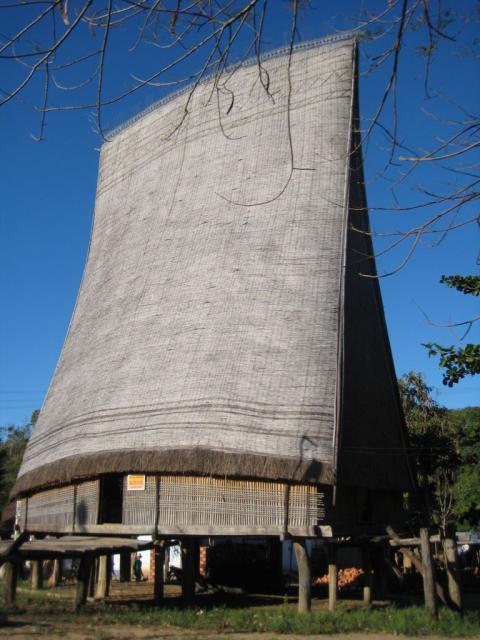
Waving goodbye to the children, we rode to a Bahnar village, where we saw our first rong house.  Kind of like village community centers, rong houses have towering roofs, the height of which is said to indicate the wealth of their villages.  (I wonder if every village strives for a rong house roof higher than the one of its neighbor…)  We left our motorcycle in the village and set off on foot through jungle landscapes and fields where cows grazed under banana trees.   We floated back to the village in dugout boats, one of which was captained by a boy who could not have been more than six years old.  Although we had nearly as many flat tires as we did days on our motorcycle, two-wheeled travel took us to places–and led us to people–that we never would’ve encountered had we rented a car!

[embedplusvideo height=”350″ width=”450″ editlink=”http://bit.ly/1sVaZYv” standard=”http://www.youtube.com/v/79_u2TAZvKs?fs=1″ vars=”ytid=79_u2TAZvKs&width=450&height=350&start=&stop=&rs=w&hd=0&autoplay=0&react=1&chapters=&notes=” id=”ep9509″ /]

good_bad_5
I’ve heard travelers say that, when it comes to foreign experiences, there’s India, and then there’s the rest of the world.  No place is this more true than in Delhi.  ((I’ve always been confused about the difference between “Delhi” and “New Delhi.”  From what I’ve read, it seems that “Delhi” encapsulates both “Old Delhi”–the capital of pre-British, Islamic India–and “New Delhi,” which was constructed by the Brits as their imperial capital.))  Our family has an apartment in Delhi, and the promise of both their company and free lodging kept us there for more than two weeks.  In that time–longer by far than we’ve spent in any other place on our itinerary–we got to know at least three of Delhi’s multiple personalities.  Allow me to introduce you to The Good, The Bad and The Wildly Confusing.

The Good:
good_bad_2
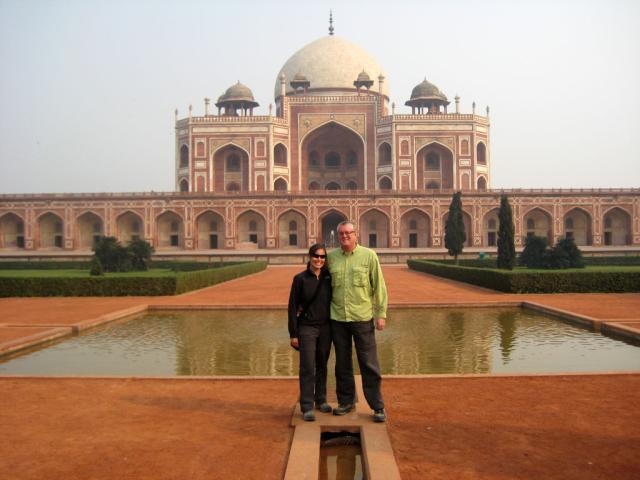
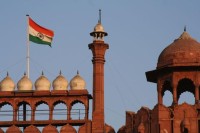
Delhi boasts both an incredible past and a wonderfully vibrant present.  We had a great time touring its many attractions and fell particularly in love with the Red Fort, where a tour guide ((In the past four months, we’ve learned that a good tour guide–generally hired at the location we’re touring and for that location alone; we fear the umbrella-led tour group–can really help us get the most out of the places we’re visiting.  We always talk with the guide first to ensure that he or she speaks great English.  And then we bargain.  Hard.)) made the place come alive for us as he described the luxuries that existed within its thick, sandstone walls during the reign of the Mughal emperor who ruled from there.   We also really enjoyed exploring Humayun’s tomb, an amazing example of Mughal architecture that looks a lot like the Taj Mahal’s little brother.

Another highlight was a visit to the sprawling, 2005-built Akshardam Temple.  The fact that it felt a little like Disney World at times (never before have I seen a food court in a place of worship…) didn’t completely undermine its astonishingly intricate marble and sandstone carvings.  A lot of the temple is still being constructed, so we were able to watch artisans as they created the marvels that, 500 years from now, someone will look at in wonderment and say “how did they make something like that way back then?”.
good_bad_4
The evenings that we spent at an assortment of wedding and new year’s festivities demonstrated to us how incredibly alive and colorful Indian culture is.  Old traditions and new mixed and thrived at these incredible events, where the outstanding food and the vibrating music served as constant reminders that this country really knows how to throw a party.  Watching 20-somethings honor their religion and their family through age-old traditions and seeing grandparents on the dance floor, grooving to a techno remix of Om Shanti Om, I felt proud to be half-Indian.  Sadly, my impressions of Delhi didn’t end there.

The Bad:
good_bad_1
Right down the street from those luxurious parties, people live in slums, burning trash to stay warm as their children turn cartwheels in the crowded streets to try to earn a few rupees from spectators watching from the safety of their cars.  While Delhi’s economy is growing, the gap between the rich and the poor seems terrifyingly wide.  India has the largest population of child laborers in the world (estimated by human rights groups at an astounding 60 million), and this fact is dramatically illustrated throughout Delhi’s streets.

Speaking of streets, the traffic in Delhi is so bad that it’s almost comical.  (We could laugh at the traffic delays because, given our blessedly easy lives at the moment, we rarely had to be anywhere at a certain time.  I can’t imagine the stress that would accompany having to actually arrive someplace at a certain hour.)  We had to allow 45 minutes to an hour to get anywhere by car.  Happily, Delhi has a sparkling new subway system that will hopefully alleviate some of the strain on its roads.

For now, all of those cars, trucks, buses and auto-rickshaws are teaming up to create some wicked air pollution.  I often felt like I was breathing in solid particles (probably because I was…) and, when I ran a white washcloth over my face at the end of the day, the cloth turned gray.  What’s more, Delhi’s streets are littered with trash unlike any I’ve ever seen.  Every corner seems to be growing its own landfill.  The environmental situation is bad and getting worse, which leads me to…

The Wildly Confusing:
good_bad_3
India has environmental laws, but they’re often not enforced.  It has traffic laws (surely?), but the only traffic police I saw in Delhi were the ones helping to control the scene of an accident.  It may even have anti-littering laws but, from the state of things, those would seem to be a waste of the paper on which they’re written.  The lawyer in me mourned for the lack of law and order in Delhi.  (That’s the lowercase “law and order”; I’m can almost guarantee that the TV show is regularly available on cable.) I polled the locals, i.e., my family members, on the cause of this sorry state of affairs.  Many of them pointed the finger at corrupt government officials.  The thinking seems to go like this: why bother following the law when it’s cheaper and easier just to bribe the government official tasked with enforcing it? It pained me.

Less painful but similarly bothersome were the gaggles of ogling young men that seemed to lurk around every corner.  They rarely spoke, but they followed me, took pictures of me and stared so much that I bought sunglasses to avoid having to make eye contact with them.  Even the “I’m going to really hurt you if you don’t stop staring at my wife” looks constantly given by the 6″4 Derek rarely seemed to phase them.  I know that Delhi is not alone in this annoyance–friends living in the Middle East and Latin America complain of more of the same, and it’s certainly commonplace throughout India as a whole–but I was never able to figure out (1) why the men were staring and (2) why they weren’t embarrassed by their own behavior.  ((India has been more focused lately on the harassment perpetuated there by some men.  On New Year’s Eve, two California-based Indian women were attacked by a gaggle of men as they left a Bombay night club.  A press photographer got it all on film, and the ugly scene has since been splashed across the front pages of India’s many newspapers.))

Although Delhi’s challenges made it somewhat more difficult to enjoy, enjoy it we did.  The city has so much in store for travelers–from ancient ruins to modern dance clubs, from bustling markets to shiny new shopping malls–that it’s worth the effort it takes to uncover its gems.

Warning: Because this entry discusses cremation in fairly vivid detail, it may not be for everyone.
city_of_life2
Varanasi is to Hindus as Mecca is to Muslims or the Vatican is to Catholics: many of the religion’s most devout spend a lifetime planning and saving for the visit they hope to someday pay to the holy city.  A journey to Varanasi is of specific significance: dying here is said to liberate Hindus from the endless birth-death cycle attendant to the repeated reincarnation in which they believe.  Although it was once named Kashi, or “city of life,” Varanasi is a town where many people come to die.
city_of_life3
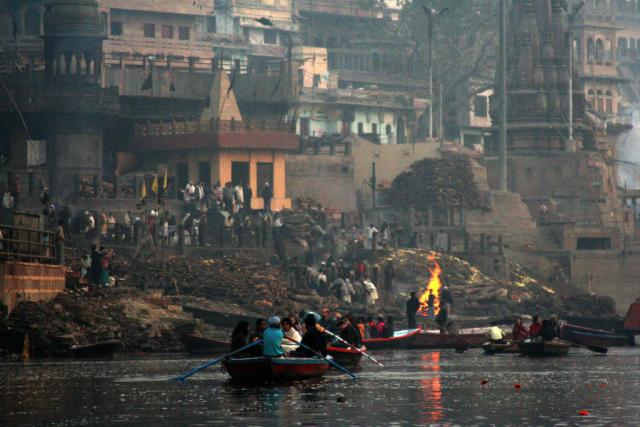
The Ganges runs through Varanasi, and many of the dead are cremated on the wide steps (or “ghats”) that lead to the water.  Some ghats, known as “burning ghats,” are used specifically for this purpose, and it was at one of these that Derek and I witnessed the many stages of a Hindu cremation.  We watched dead bodies swathed in brightly colored cloth being carried through Varanasi’s narrow alleyways and down to the river, where they were doused in the holy waters and then placed upon a pyre fed with wood and fuel.  Upon incineration, societal outcasts employed specifically for funereal purposes threw the ashes into the Ganges’s slow-moving current.  In the case of holy men and children, we learned, the cremation process is bypassed entirely in favor of throwing the bodies directly into the river.  I guess it goes without saying that we found the whole process fairly overwhelming.  Still, we were glad to play witness to this most holy of practices.
city_of_life1
Varanasi seems to be a place better observed than toured.  Rather that visiting every site that our guidebook recommended, we spent our time wandering the city’s ghats, exploring its streets and taking in the life along its riverbanks during an early-morning boat ride.  Like so much of India, Varanasi is equal parts chaos and vibrancy–a photographer’s dream and a place where we felt very lucky to spend a few days.

Varanasi Video

[embedplusvideo height=”350″ width=”450″ editlink=”http://bit.ly/1t0snuQ” standard=”http://www.youtube.com/v/4MhvtcDcX60?fs=1″ vars=”ytid=4MhvtcDcX60&width=450&height=350&start=&stop=&rs=w&hd=0&autoplay=0&react=1&chapters=&notes=” id=”ep6613″ /]

clap_your_hands_2
To be honest, I was fairly skeptical about the commitment I’d made to my yoga-instructor mother to spend a few days at an Indian ashram with her when she and my father met us in India this month.  Looking at the ashram’s website, which featured an orange-clad guru surrounded by orbs of twinkling lights and informed would-be participants that their days would start promptly at 4:30 a.m. (a morning person, I am not…), did nothing to calm my nerves.  I made my way to Rishikesh, the home of the ashram–and, incidentally, the place to which the Beatles retreated during their new-age phase–repeating the mantra “I can do anything for three days.”
clap_your_hands_3
I had no idea that those three days would be so enjoyable.  The ashram lifestyle proved to be a lot more flexible than I’d imagined, particularly for short-termers like me.  I could choose among the center’s offerings at will and spend the rest of my days exploring our nearby surroundings.  Derek and I had a great time wandering around the town, which sits on the banks of the much-revered Ganges.  The people-watching alone made the trip worthwhile: mellow, dreadlocked backpackers shared the narrow streets with a collection of even-more-mellow sadhus, a wide variety of souvenir hawkers and a truly overwhelming number of cows, monkeys and dogs.  The menagerie ensured that getting from one place to another was always an adventure.

From Rishikesh, we made our way downriver to Hardiwar, a city that is sometimes known as the spiritual (if not the actual) source of the Ganges.  Every few years, Hardiwar plays home to the Kumbh Mela, a festival that attracts millions of pilgrims and is reported to be the largest religious gathering in the world.  The next one won’t take place until 2010 but, even without it, Hardiwar had plenty to offer.
clap_your_hands
We spent the day exploring area temples, each one of which seemed more colorful (and, frankly, more Disney World-like) than the last.  Never before have I entered a house of worship by stepping into a gigantic, paper-mache cave.  Never have I received holy water by means of a coin-operated religious figure.

In the evening, we joined hordes of people on the riverbanks for the nightly aarti, or river worship ceremony.  Along with so many others, we placed in the Ganges a leaf basket filled with flower petals and a glowing candle and watched it drift away with the current, past pilgrims washing away their sins in the holy river and off to other cities made holy by the river’s mere presence.

[embedplusvideo height=”350″ width=”450″ editlink=”http://bit.ly/1t0ufDO” standard=”http://www.youtube.com/v/tNBe_0SOQQw?fs=1″ vars=”ytid=tNBe_0SOQQw&width=450&height=350&start=&stop=&rs=w&hd=0&autoplay=0&react=1&chapters=&notes=” id=”ep2527″ /]

monsoon_1
Until last week, all of my impressions of Indian weddings were based on Monsoon Wedding, my favorite movie of all time.  Little did I know that some Indian weddings are of a variety even better than the ones seen on the big screen.

The stars of this show were my cousin, Priya, and her now-husband, Druv.  Our family poured in from around the U.S. and throughout India to join in the celebrations, which kicked off with a cocktail party that would put Bollywood to shame.  There was a rose petal-lined red carpet that led to a huge, red tent, crowds grooving to bhangra tunes and waiters bearing trays of multi-colored kamikaze shots.  Enough said.
monsson4
Next came the traditional pre-wedding application of henna to the hands of many female family members (myself included!) and to the hands and feet of the bride.  (The henna-application process requires some patience; Priya sat still for hours as the artisans applied the herbal mixture, and then for hours more while the whole thing dried.  The intricate designs will last for weeks.)
monsoon3
The next day brought the somber ceremony that marks the bride’s transition from her home to the home of the groom.  (Priya, like most Indian women, lived with her parents until she got married.  Now, she’ll move into the house that Druv shares with his extended family.)  As you may have seen in the movies, the groom arrives at this ceremony aboard a white horse, accompanied by a parade of his singing and dancing family members and by a horn band.  (Sadly, the horse and the band weren’t allowed inside the military area where the event was taking place, so we didn’t get to see them, although we heard them coming.) The evening was capped off by a traditional Hindu wedding ceremony, which took place at about 2:00 a.m.; what a different world!
monsoon2
The following day ((As you can tell by now, the length of Indian weddings is measured in days, not hours.)) brought festivities put on by the groom’s family to celebrate the addition of its newest member.  Out came the red tent, along with hordes of waiters passing every kind of Indian appetizer imaginable, a buffet line that Derek is still dreaming about and the most opulent clothing and jewelry I’ve ever seen.  The wedding celebrations came to a close a couple of days later with a Sikh ceremony that honored my family’s traditions.

Having grown up on the other side of the world, I haven’t had a chance to spend much quality time with my many family members who live in Delhi.  Priya’s wedding gave me not only that chance, but also the opportunity to experience all of the colorful splendor that comes with an Indian wedding. The whole thing felt like a very fancy American wedding that had been dipped in colorful paint and then rolled in glitter.  We absolutely loved it.

[embedplusvideo height=”350″ width=”450″ editlink=”http://bit.ly/1t0vhj6″ standard=”http://www.youtube.com/v/Vtt2fH0E5gI?fs=1″ vars=”ytid=Vtt2fH0E5gI&width=450&height=350&start=&stop=&rs=w&hd=0&autoplay=0&react=1&chapters=&notes=” id=”ep6486″ /]

Munnar tea fields
After the houseboat docked (sad! We weren’t ready for the trip to end…), we climbed aboard an antique-looking Ambassador (the ubiquitous car of India) and set off on an arduous, 4 1/2-hour drive into the hills of Munnar.  Munnar plays home to a number of tea estates and spice plantations, whose greenery combines to give the whole area a Sound-of-Music-like feel that seems far removed from the general chaos of the rest of India.  During their imperial days, the British used to come here to escape the heat, and with good reason: the higher the Ambassador climbed, the more the temperature dropped.  
Munnar tea fields
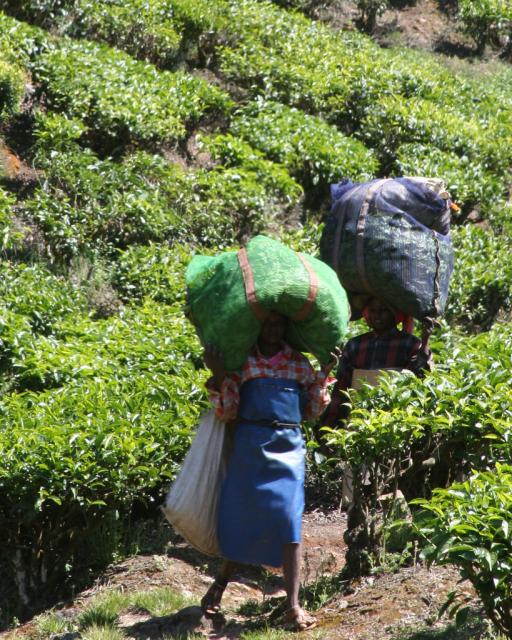
Although we didn’t have much time to spend in Munnar (the Andaman Islands were calling our name), we were able to visit a tea museum, where we got a brief lesson on the art of tea production.  We also stopped to watch a group of women harvesting tea leaves; waist-deep in the impossibly green and manicured tea trees, they gave us a new appreciation for all of the hard work that goes into creating our cups of Lipton.

a_return_2
After a long day of flying and the discovery of a new airline nemesis in Jet Airways (Air Asia may have had interminable delays, but at least they didn’t destroy my backpack!), we stepped out into the tropical air of Kerala, a meandering and idyllic state in Southern India.

Interestingly, in 1957, Kerala became the first state in the world to freely elect a communist government. Despite Communism’s relative failure in other parts of the world, the Keralan system boasts an impressive track record. Labeled the “most socially advanced state in India,” its 91% literacy rate is the highest of any developing nation and it’s 73-year life expectancy is 10 years higher than the rest of India.
a_return_3
Upon our arrival in Kerala, we found our way to a lovely homestay in Fort Cochin, with hosts Mary and Harry. Enjoying the incredible meals that our hosts offered up, we basked in the knowledge that we were back in a country celebrated for its food. Bring on the curries, the puri, the spice!

This area has been colonized by Portuguese, Dutch and English settlers alike. As a result, many of its charming buildings have a distinctly colonial feel. We spent two relaxing days exploring the town via foot and motorcycle (an adventure in itself on India’s crazy streets!), watching local fisherman maneuver their huge nets and joining Indian weekenders at nearby Cherai Beach.
a_return_1
Because my father is from Delhi, my family has been to Northern India a couple of times, but, until now, I’ve never ventured down south. The Kerala tourist board proudly touts this area as “God’s Own Country.” Right now, that seems pretty close to the mark. As I write this, we’re partaking in Kerala’s star attraction; that is, we’re floating along its lazy, palm-lined backwaters aboard a houseboat built for two (along with, err, a chef and two drivers). The sun is setting, it’s a balmy 75 degrees, and I just snacked on bananas fried in coconut. Sometimes, long-term travel is difficult. This is most definitely not one of those times.

[embedplusvideo height=”350″ width=”450″ editlink=”http://bit.ly/1t0wcQE” standard=”http://www.youtube.com/v/xE0x6ftV3fA?fs=1″ vars=”ytid=xE0x6ftV3fA&width=450&height=350&start=&stop=&rs=w&hd=0&autoplay=0&react=1&chapters=&notes=” id=”ep9384″ /]

christmas_comes
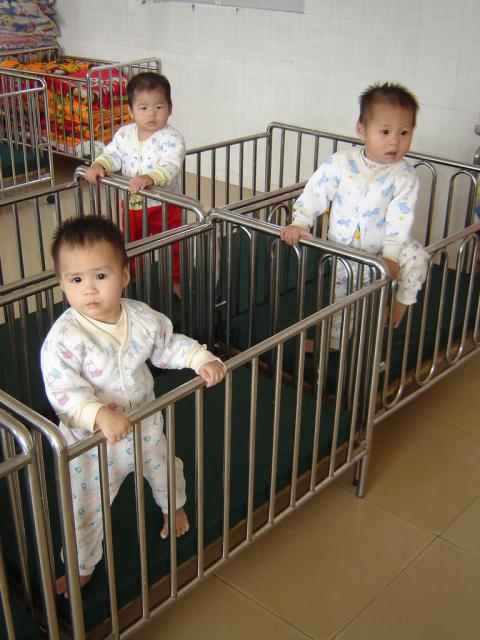
Many of you already know about our October visit to the orphanage in Yangxi, China.   We fell in love with the girls during our time with them, and we really struggled with the fact that they slept (and, really, lived) in metal cribs with rough, wooden bottoms.  Overwhelmed by their many trying circumstances, we left determined to remedy at least one of them by purchasing mattresses for their cribs.  Such a task surely would have been impossible without the aid of our friends and family, who donated an incredibly generous amount of money to help with the task, and Wensi, an amazingly kind employee of the orphanage’s umbrella agency, who coordinated a Chinese factory’s production of the mattresses. 
christmas_comes_2
We’re so excited to report that 120 thick, washable mattresses have just been delivered to the orphanage and placed in the cribs.  As evidenced by the pictures, the before/after contrast is profound.  We really feel like Christmas has come early this year, as much for us as for the orphanage’s children.  Thank you, thank you to all who helped with our efforts!

Kathmandu.  Long a backpackers’ haven, the celebrated destination of a Bob Seger song and the place where we, along with Nashville friends Michael and Kelly, spent a fantastic few days.
going_to_kath_2
Among the highlights were a walk around the kora with Buddhist pilgrims at the Bodhnath Temple, time spent with the gaggle of monkeys at the Swayambunath Stupa (one of Kathmandu’s most important Buddhist shrines) and a visit to the magnificent Sweta Machhendranath Temple, which we stumbled upon during our Derek-led walking tour the of the city (hey, they don’t call him “Map Boy” for nothing…).  The latter, which is revered by Buddhists and Hindus alike, boasted far, far more pigeons than people and provided a great opportunity for us to watch worshippers making offerings.
going_to_kath_3
We were also lucky to get a quick glimpse of Kathmandu’s own living goddess (although we were forbidden to take pictures of her–the one here was pilfered from a postcard).  The young goddess, known as the Kumari, is believed to be the bodily incarnation of the goddess Taleju.  In order to be chosen as the Kumari, she had to meet a staggering number of requirements designed to ensure that she was, in fact, the goddess’s reincarnation.  Among many other necessities, she had to be a Buddhist girl from a certain caste who has, and I quote, “a neck like a conch shell,” “a body like a banyan tree” and “eyelashes like a cow.”  Hmmm.

For Derek and me, Kathmandu was this trip’s first real taste of the colorful chaos of a South Asian city.  After China, with its cool temperatures and often-gray atmosphere, the city was a burst of warmth and life.  We happily wandered the city’s crazy streets and grew adept at avoiding both tiger balm sellers and wayward scooters.
imgoing_to_kath
Better yet, all four of us were delighted (and surprised) to find that the talented chef at the Kathmandu Crowne Plaza could produce a tasty approximation of a Thanksgiving dinner with only a few hours’ notice.  We had all the fixin’s–from mashed potatoes to pumpkin pie–and we’re still puzzling over how he brought forth such a wonderful turkey without the full day of cooking that such a task usually takes us.
going_to_kath4
Kathmandu cab drivers and hoteliers alike lamented to us about the drastic reduction in tourism that their part of the world has felt in recent years.  Due at least in part to Nepal’s precarious political situation–unrest has rocked the country for over a decade as the Maoists in rural Nepal struggle against the nation’s monarchy and its chosen political system; the situation famously worsened in 2001 when Prince Dipendra, in a rage purportedly sparked by his parents’ refusal to accept his chosen wife, murdered his father, the king, and many other family members–it appears on many state departments’ “exercise caution” lists.  For travelers who do find their way to Kathmandu, these difficult circumstances ironically mean reduced prices and a wide choice of available hotel rooms.  For Kathmandu residents, however, they translate into a staggering unemployment/underemployment rate–nearly 50%–and fervent hopes that a political solution lies just on the horizon.

[embedplusvideo height=”350″ width=”450″ editlink=”http://bit.ly/1t0xeMF” standard=”http://www.youtube.com/v/PFhjHPY931w?fs=1″ vars=”ytid=PFhjHPY931w&width=450&height=350&start=&stop=&rs=w&hd=0&autoplay=0&react=1&chapters=&notes=” id=”ep3763″ /]